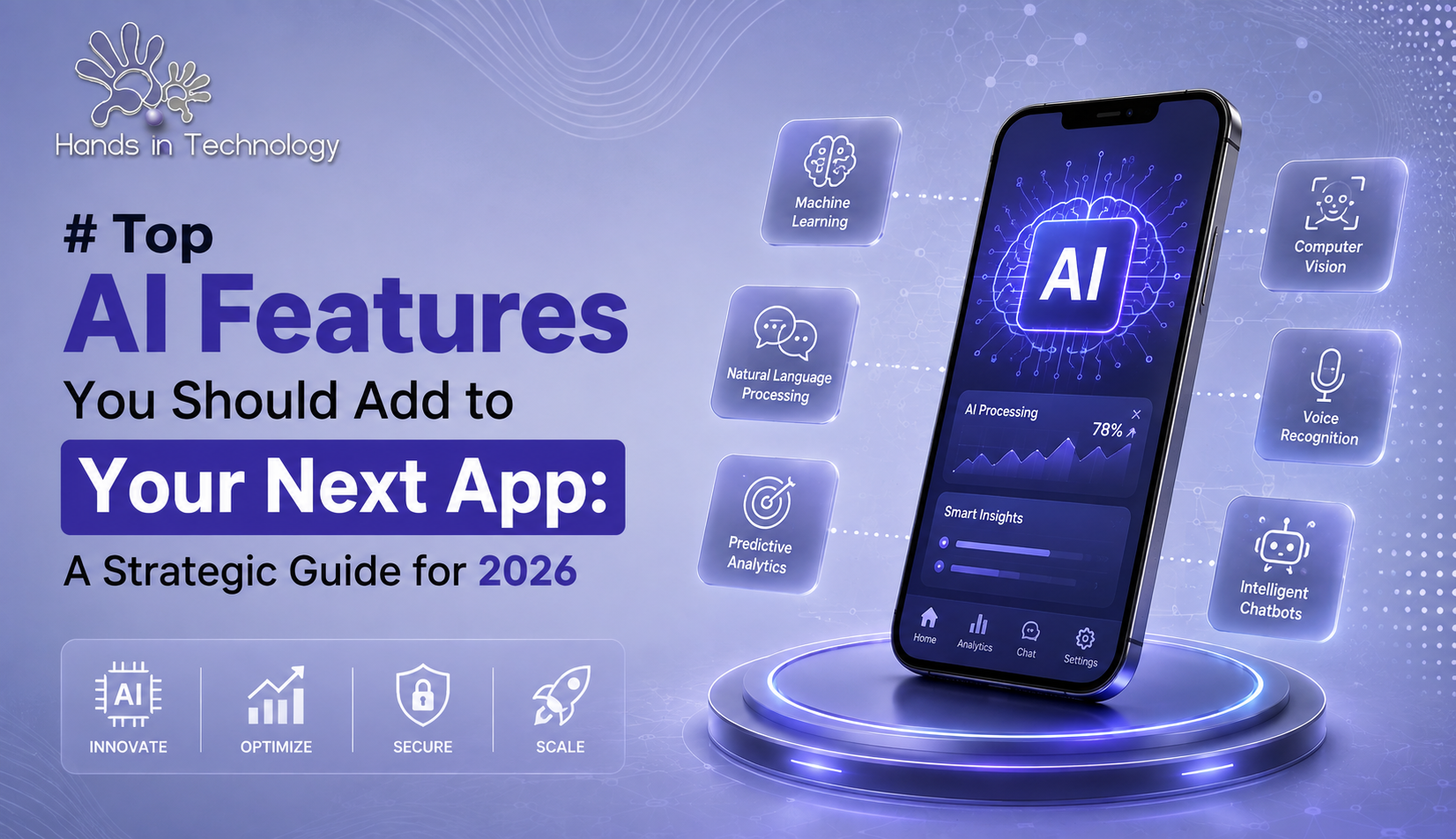
Any application not incorporating any AI features is already at a disadvantage in the marketplace today. Top AI Features to include in your next app shouldn’t be only enterprise or added value features. They are not actually nice-to-haves, they should be must-haves to assure your application remains relevant and competitive, and most important, will be attractive and desired by users. Knowing these features as much as possible before you begin to develop assures that your product doesn’t become extinct.
Introduction
The entire way that applications have been built has been turned on its head. Product teams previously cared about the slick UI and the number of features; now they have to care about intelligence, automation, and context-awareness. Determining which AI features add value and don’t add complexity at the expense ofROI will be what separates a product that grows and a product that goes to die after release. We guide you through with clarity.
1. Why AI Features Define Modern Application Performance
User expectations have expanded beyond standard application features. Customization, predictions, and automation are no longer differentiators – they are table stakes.
The business case for AI applications is measurable.
Applications without AI functionality are increasingly disadvantaged as successive versions come to market, offering competitors an intelligence advantage.
2. Top AI Features You Should Add to Your Next App
Personalisation Engine
Personalisation engine personalises content, recommendations and work-flows in an application to a specific user profile based on their behavior. Key functionalities:
- Behavioral analysis –monitoring and analysis of how users interact with an application in order to show relevant content.
- Dynamic content delivery –adjusting the content a specific user is shown to their individual preferences and usage history.
- Personalized notifications timing –sending alerts to a specific user at the time he is most likely to respond.
This will translate to significant increase in the time users spend, conversion rates, long-term retention rate.
Intelligent Search
The standard keyword search no longer fulfills users who want contextual, intent-aware search results. Intelligent search provides:
- Understand natural language queries
- Semantic search with meanings (not just keyword matching)
- NLP-enabled search and correction and Auto-complete
Conversational AI and Chatbots
Integrating conversational AI allows for better user experience in scale while reducing support overhead.
- Intent recognition with multi-turn dialogue management
- Seamless handoff to human agents when query complexity exceeds AI capability
- Multilingual support for global application deployments
Predictive Analytics and Recommendations
Predictive features turn historical data into forward-looking business intelligence. Applications leverage this for:
- Product and content recommendation engines
- Churn risk scoring with proactive intervention triggers
- Demand forecasting embedded directly within operational dashboards
Computer Vision Capabilities
Visual AI unlocks powerful, camera-driven functionality across enterprise and consumer applications:
- Document scanning and OCR extracting structured data from unstructured documents
- Visual product search allowing users to search by image rather than text
- Biometric authentication facial recognition for secure, frictionless login
Anomaly Detection and Intelligent Alerts
Rule-based alerting generates noise. AI-powered anomaly detection identifies genuine deviations requiring attention:
- Financial transaction fraud detection in real time
- Equipment performance degradation alerts in field service applications
- Security breach pattern recognition within enterprise platforms
Voice Recognition and Voice Commands
Voice-enabled interfaces expand accessibility and accelerate user workflows. Key voice AI features include:
- Voice-to-text with domain-specific vocabulary recognition
- Command execution through natural speech input
- Voice biometrics for identity verification
Automated Workflow Intelligence
AI-driven workflow automation eliminates repetitive manual processes within applications. Automation features deliver value through:
- Intelligent document routing and approval workflows
- Auto-categorisation of incoming data and requests
- Contextual task prioritisation based on deadline and dependency analysis
3. AI Features by Application Type
Different application categories demand different AI feature priorities.
| Application Type | Priority AI Features |
| E-Commerce | Personalisation Engine, Visual Search, Recommendations |
| Enterprise SaaS | Predictive Analytics, Workflow Automation, Anomaly Detection |
| Healthcare | Computer Vision, Voice Recognition, Intelligent Alerts |
| Fintech | Anomaly Detection, Conversational AI, Predictive Scoring |
| Field Operations | Voice Commands, Computer Vision, Intelligent Notifications |
Selecting AI features without mapping them to specific application use cases leads to bloated builds with low feature utilisation.
4. Implementation Considerations Before You Build
Define the Problem Each Feature Solves
Every AI feature must map to a defined business problem or user pain point. Features added without this mapping increase development cost without generating proportional value.
Assess Data Availability
AI features require structured, sufficient data to function accurately. Teams must audit:
- Existing data assets and their quality
- Data collection mechanisms required for features not yet in production
- Compliance obligations governing data usage in the target market
Plan for Ongoing Model Management
AI features degrade without active maintenance. Build teams must account for:
- Model monitoring and drift detection post-launch
- Retraining pipelines to maintain accuracy as data evolves
- Version control and rollback protocols for model updates
Conclusion
AI strategically applied can turn an application from high performance into obsolete in months of launch. The Top 5 AI Features you must incorporate into your next app – from Personalization and Predictive Analytics to Conversational AI, Computer Vision and Workflow Automation are the layer of intelligence every competitive application today needs. Businesses that design these features at the architectural level will see increased time-to-value, user adoption and improved long term performance.
Hands in Technology designs and develops AI-enabled applications focused on your business goals and user needs. Partner with Hands in Technology today to develop an application in which all AI features add valuable and lasting benefits.