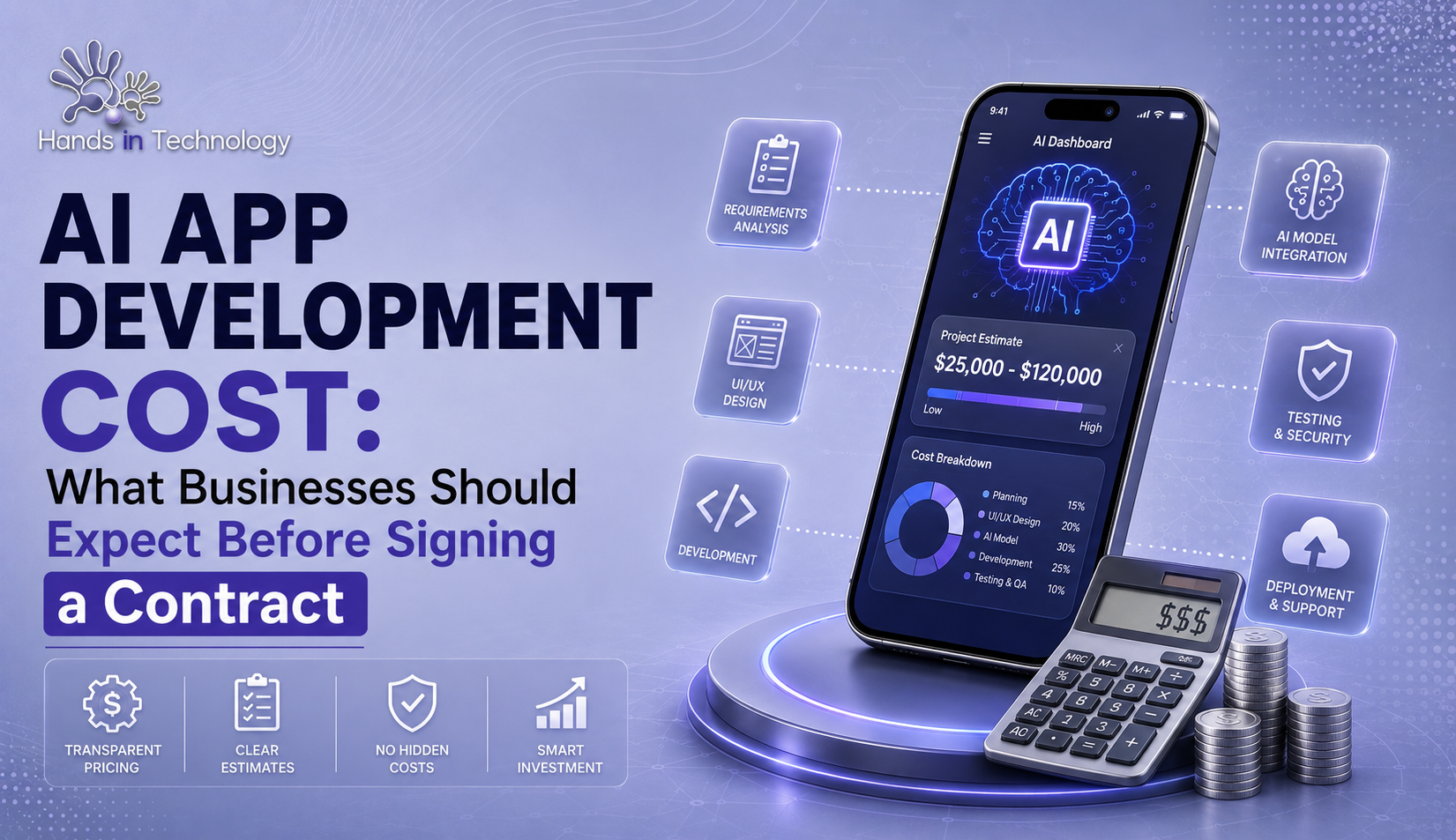
The biggest, and perhaps the costliest error a company can make when it comes to AI is to underestimate its development price. AI App Development Cost: What Businesses Should Expect is more than just development price tag; it also implies data infrastructure, model training, complexity of integration and running costs commitment. Building AI without the frame of costs for project can easily lead to the violation of budget and poor results.
Introduction
Development cost structure for an AI application is substantially different from any software project. There is wider variety in variables, higher expertise demands, and more post-launch responsibilities. Organizations with realistic, planned assumptions about development cost, are better at choosing their vendor, scoping the project and have higher ROI from their tech investment.
1. Why AI App Development Costs Differ From Standard Software
For normal software projects the cost curve is fairly predictable. This is not the case for AI. The differences are mainly split into 3 categories.
1. Data dependency: AI systems need significant quantities of structured, labelled and well governed data. Getting this data, cleaning it and keeping it managed and organized incurs costs even before any model is trained.
2. Unique talent: AI requires a data scientist, ML engineer or AI architect which is not a standard developer and command significantly higher salaries.
3. Iterative modeling: As opposed to normal features AI models need to be trained and validated a number of times. Each run takes computation power and engineering time.
2. AI App Development Cost: What Businesses Should Expect by Project Type
Minimum Viable Product with Pre-Trained AI Models
Utilizing existing foundation models (GPT, BERT, Vision APIs) and custom fine-tuning them:
- Cost: $15,000 – $80,000
- Time: 2-4 months
- Best suited for: Startups/Businesses needing to quickly validate AI concepts.
Mid-complexity AI application
Integration of a custom model to existing data pipelines, API layers in enterprises:
- Cost: $80,000 – $250,000
- Time: 4-9 months
- Best suited for: Businesses wanting to embed AI into existing enterprise applications.
Enterprise-level custom AI platform
Custom AI model architectures, multi-system integration, custom security and compliance:
- Cost: $250,000 – $1,000,000+
- Time: 9-24 months
- Best suited for: Enterprises with a unique data set and business process that cannot leverage existing models and APIs.
3. Primary Cost Drivers in AI Application Development
Data Acquisition and Preparation
AI training data costs represent a significant and frequently underestimated budget line. Cost factors include:
- Volume of labelled data required for model accuracy targets
- Third-party data sourcing or synthetic data generation expenses
- Data cleaning, transformation, and pipeline engineering fees
Model Development and Training
Custom model development involves:
- Algorithm selection and architecture design
- Compute costs for cloud-based training infrastructure (GPU/TPU hours)
- Validation cycles and hyperparameter optimisation iterations
Indicative cloud compute costs for model training: $2,000 – $50,000+ depending on model complexity and dataset size
Team Composition and Engagement Model
| Role | Average Hourly Rate (Global) |
| AI/ML Engineer | $80 – $200/hr |
| Data Scientist | $70 – $180/hr |
| AI Architect | $100 – $250/hr |
| Backend Developer | $40 – $120/hr |
| QA Engineer (AI) | $35 – $90/hr |
Engagement model in-house, nearshore, or offshore significantly impacts total team cost.
Integration Complexity
AI applications rarely operate in isolation. Integration costs scale with:
- Number of existing enterprise systems requiring connection
- API development and third-party service licensing fees
- Data synchronisation and real-time processing architecture requirements
4. Hidden Costs That Expand AI Budgets Post-Launch
The vast majority of AI budget overruns don’t occur during the development phase but rather post-production. Post-production budget categories often not accounted for:
- Model Monitoring (tracking model accuracy and performance decay over time, detecting model drift)
- Retraining Pipelines (triggered or timed retraining of models to cope with evolving real-world data)
- Compliance Changes (updates required to AI models and accompanying documentation for new regulations related to AI governance)
- Infrastructure scaling (cloud computing resource usage grows with increased users and data throughput)
- Security Audits (third-party security assessment for systems processing sensitive information)
Companies that incorporate these future obligations into the initial budgeting phase, do not experience unexpected operational challenges that destroy the ROI of AI programmes.
5. How to Structure an AI Development Budget Effectively
Allocate by Phase, Not Total Project
Phased budget allocation reduces financial exposure and enables course correction between milestones:
- Discovery and Feasibility 10–15% of total budget
- Data Strategy and Preparation 15–25% of total budget
- Model Development and Testing 30–40% of total budget
- Integration and Deployment 15–20% of total budget
- Post-Launch Support and Iteration 15–20% of annual recurring budget
Build a Contingency Reserve
AI projects carry higher uncertainty than standard software. Budget a minimum 20% contingency reserve for scope adjustments, model performance issues, and integration complexity.
Evaluate Build vs. API vs. Fine-Tune
Not every AI capability requires custom model development. A structured build-vs-buy analysis across each AI feature reduces unnecessary expenditure without compromising application intelligence.
Conclusion
Failing to estimate costs up front in the AI decision process causes budget over-runs, missed delivery targets, and inefficient vendor partnerships. The cost of AI App Development, expected by businesses, include the data infrastructure, model development, the talent involved, and the integration architecture, and the ongoing costs of the AI post deployment. Organisations who set realistic cost expectations and plans in phases prior to development with a partner, always have a better return on investment and predictable project results.
Hands in Technology delivers structured AI application development with full-cycle cost transparency from feasibility assessment through to production deployment. Engage Hands in Technology to establish a precise, defensible AI development budget aligned to your organisation’s objectives and technical requirements.