When selecting a software partner you should never take anything for granted; technically and even down to the wording of the contract there is always a risk element involved. Businesses that operate within a structured process system see far superior software results. The businesses who defer AI adopt it. They are actually falling behind the race. AI App Development: A Complete Business Guide is available because many organisations dive head first into AI projects with absolutely no process system involved at all leading to failure of the MVP, a lost budget and objectives that do not align with actual development. Having strategic clarity prior to commencing any development work is without doubt the number one investment a business can make.
Introduction
Choosing a software partner should not be treated lightly, there are no givens. From technical capability to phrasing on your contract there’s a level of risk. Companies with a structured, system-based approach tend to have the highest success rates on their software project.
The business world now considers the usage of Artificial Intelligence to be a must rather than a competitive advantage. Businesses within all sectors, logistics, healthcare, finance, and retail are adopting the usage of AI based applications for automation of decisions, operational cost savings and personalization. Comprehension of cost structure, development life-cycle and strategic decision-making in AI application development will influence whether a solution either develops and is implemented or fails to get off the ground.
1. What AI App Development Actually Involves
The choice of software partner is something that you should be thinking carefully about and not taking for granted. From their technical capabilities through to the wording within your contract there’s always some level of risk, and firms that can take a methodical and organized approach to it get vastly more out of their software development efforts.
The practice of AI app development cannot be treated like any normal software engineering, instead it is something that must be combined as one multifaceted field consisting of data science, machine learning engineering, and product development.
The primary components in any AI app will be:
- Data Infrastructure : The way data is collected, cleaned and labeled
- Model Development : The training, testing and tuning of algorithms
- Application Layer : The system where users can consume the outputs from the AI system
- Feedback Loop : A means by which AI performance can be monitored and improved based on real world interaction
The ability to handle any of these require highly specific expertise; if any aspect cannot be sufficiently addressed by your partner then your system’s performance and reliability can suffer greatly.
2. Types of AI Applications Businesses Build
Predictive Analytics Applications
These applications analyse historical data to forecast outcomes. Common use cases:
- Demand forecasting in supply chain
- Customer churn prediction in SaaS
- Financial risk scoring in banking
Natural Language Processing (NLP) Applications
NLP powers text and voice-based AI tools. Deployments include:
- Intelligent chatbots and virtual assistants
- Document classification and extraction
- Sentiment analysis for customer feedback
Computer Vision Applications
Visual AI solutions process image and video data. Business applications include:
- Quality inspection in manufacturing [INTERNAL LINK: AI for Manufacturing]
- Identity verification in fintech
- Retail shelf monitoring and planogram compliance
Recommendation Engines
Personalisation engines drive revenue across e-commerce, media, and EdTech platforms.
3. AI App Development: A Complete Business Guide to the Build Process
Phase 1: Problem Definition and Feasibility
No AI project should begin without a defined problem statement. Teams must determine:
- Whether the problem genuinely requires AI or can be solved with simpler logic
- Whether sufficient, quality data exists to train models
- What success metrics define project completion
Phase 2: Data Strategy
Machine learning model development depends entirely on data quality. This phase involves:
- Auditing existing data assets
- Identifying data gaps requiring third-party sourcing or synthetic generation
- Establishing data governance and compliance protocols [INTERNAL LINK: Data Strategy Consulting]
Phase 3: Model Selection and Development
Teams select algorithms based on the problem type classification, regression, clustering, or generation. Key decisions include:
- Build custom models vs. fine-tune pre-trained models (GPT, BERT, Vision Transformers)
- On-premise vs. cloud-based model hosting
- Latency requirements for real-time vs. batch inference
Phase 4: Integration and Deployment
AI models deliver no value until embedded within usable applications. Deployment involves:
- API development for model serving
- UI/UX design aligned with AI output consumption
- Load testing for production-scale performance
Phase 5: Monitoring and Iteration
AI applications degrade over time as real-world data shifts. Continuous monitoring must track:
- Model accuracy and drift detection
- User interaction patterns and edge case failures
- Retraining schedules and version control
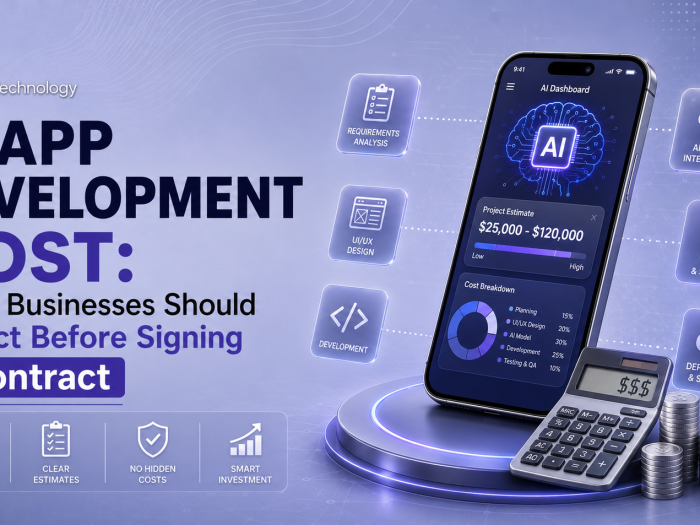
4. Cost Factors in AI Application Development
AI development costs vary significantly based on scope and complexity.
| Cost Factor | Estimated Range |
| Custom Model Development | $30,000 – $300,000+ |
| Pre-trained Model Fine-Tuning | $10,000 – $80,000 |
| Data Annotation and Preparation | $5,000 – $50,000 |
| Cloud Infrastructure (Annual) | $12,000 – $100,000+ |
| Ongoing Maintenance | 15–20% of build cost/year |
Primary cost drivers include:
- Volume and quality of training data required
- Whether custom model architecture is necessary
- Integration complexity with existing enterprise systems
- Compliance requirements in regulated industries
5. Common Business Mistakes in AI Projects {#mistakes}
Treating AI as a Feature, Not a System
AI is not a button to add to an existing application. It requires infrastructure, governance, and ongoing management. Businesses that treat it as a feature consistently underinvest in the data and monitoring layers.
Starting Without a Data Readiness Assessment
Organisations frequently commission AI development before auditing their data. Unstructured, inconsistent, or insufficient data forces costly delays mid-project.
Underestimating Post-Launch Obligations
AI applications require active maintenance. Model drift, regulatory changes, and shifting user behaviour demand continuous iteration not a one-time deployment mindset.
Conclusion
There can only be tangible business advantage of AI if it is grounded in a coherent strategy. AI App Development: The Complete Business Guide provides each organisation the required template right from problem definition, through to data strategy, to deployment, to continuous improvement. Businesses investing in structured AI development processes obtain improved time-to-value, increased user adoption, and superior ROI in the long term. Hands in Technology offers AI App development solutions that span from feasibility study through to production. Inquire with Hands in Technology to turn your business goals into powerful, scalable AI applications.