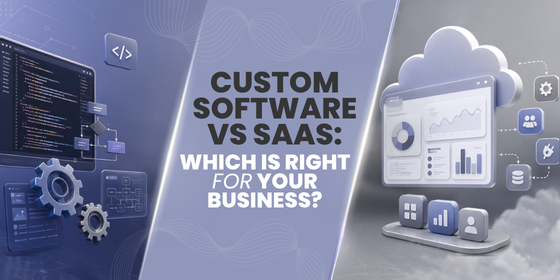
Businesses get stuck with a bad platform and it is a waste of time. They spend years trying to make it work even though it has a lot of limitations. When it comes to Custom Software versus SaaS you have to think about what’s best for your business. It is really important to think about this and make a decision.You should not just pick one because of the cost. The choice between Custom Software and SaaS is one. It needs an evaluation. Your business needs the software model. The wrong choice can affect your business for years. So you must choose wisely between Custom Software and SaaS.
Introduction
The decision to buy software is a part of every company’s plan. Some companies use SaaS platforms because they are fast and easy to use. Other companies like custom software because it is made for them and they have more control. Each type of software is good for types of companies. Custom software is not always better than SaaS and SaaS is not always better than custom software. Understanding Custom Software vs SaaS: Which Is Right for Your Business?, for your company you need to think about how complicated your company’s how fast it is growing and what you want to do with technology in the long term.
1. Understanding the Core Difference Between Custom Software and SaaS
SaaS delivers pre-built functionality through a subscription model. Custom software delivers functionality engineered specifically for your business processes.
The structural difference:
- SaaS Vendor controls architecture, features, updates, and roadmap
- Custom Software Your organisation controls scope, logic, integrations, and evolution
- SaaS You adapt your processes to fit the platform
- Custom Software The platform is built to fit your processes
This distinction drives every downstream difference in cost, capability, and strategic value.
2. Where SaaS Delivers Genuine Value
SaaS is the appropriate choice under specific operational conditions. Selecting it for the right reasons produces strong results.
SaaS performs well when:
- Business processes are standard Your workflows align closely with the platform’s native logic
- Speed of deployment is critical The business requires functional software within weeks, not months
- Internal IT capacity is limited Vendor-managed infrastructure removes operational overhead
- Budget is constrained at the outset Subscription models distribute cost over time
SaaS works great for:
- Basic CRM and project management functions
- Payroll and standard HR administration
- Entry-level marketing automation
3. Where Custom Software Outperforms SaaS
Custom development delivers superior outcomes when operational complexity exceeds what packaged platforms can accommodate.
Custom software is the stronger choice when:
- Processes are sector-specific or structurally unique No SaaS platform maps to your operational logic
- Integration requirements are complex Proprietary systems, legacy infrastructure, and multi-platform environments demand custom connectivity
- Scalability must remain in your control Vendor roadmaps rarely align with individual business growth timelines
- Competitive differentiation depends on technology Proprietary software capability cannot be replicated by competitors purchasing the same licence
Enterprise application development becomes the decisive investment when the cost of operational compromise exceeds the cost of building the right solution.
4. Decision Criteria: How to Evaluate the Right Model
Apply a structured framework before committing to either path. Gut instinct and vendor sales processes produce poor decisions at this level.
Evaluate across these dimensions:
| Criteria | SaaS | Custom Software |
| Process uniqueness | Low | High |
| Integration complexity | Low–Medium | Medium–High |
| Scalability requirements | Vendor-controlled | Business-controlled |
| Security and compliance | Standard | Configurable |
| Long-term cost structure | Recurring | Declining over time |
| Speed to deployment | Fast | Planned timeline |
Things need to retrospect before deciding:
- Do your core processes fit within standard software workflows without modification?
- How many things do your teams have to do right now?
- What will you pay in total for your software subscriptions over the five years?
- Does your company’s plan to stay ahead of the competition depend on your teams being able to do things that other companies cannot do with their capabilities, specifically with your software subscriptions and manual workarounds and operational capabilities?
5. The Total Cost of Ownership is what we need to think about when we compare things.
When people look at the costs of SaaS and custom development they usually only look at the costs they have to pay away. This does not give them a picture of the Total Cost of Ownership. The Total Cost of Ownership is important because it helps us understand the costs of SaaS and custom development.
SaaS cost trajectory:
- Year 1 costs appear lower due to subscription pricing
- Annual fee escalation, per-seat charges, and add-on costs accumulate steadily
- Integration and customisation fees inflate total spend beyond initial projections
Custom software cost trajectory:
- Higher initial investment concentrated in development and deployment
- Post-launch costs limited to maintenance, support, and incremental enhancements
- No per-seat licensing fees cost does not scale with headcount growth
Conclusion
The decision between SaaS and custom software is not about which one is better. It is about which one is better for your company. You have to think about what your company does and what you want to achieve. SaaS is a choice when you want to do things quickly and easily. It is simple to use for things that a lot of companies do. Custom software is a choice when you need something that is just for your company. It can be made to fit your company. Custom software is also a choice when your company is big and you need something that can grow with you. It can give you an advantage over companies.
Neither decision should be made without rigorous cost and capability analysis. Hands in Technology brings the domain expertise to evaluate your current environment, model your true total cost of ownership, and design a development strategy that aligns with your business objectives. When the stakes of this decision are high, Hands in Technology ensures the outcome is the right one.