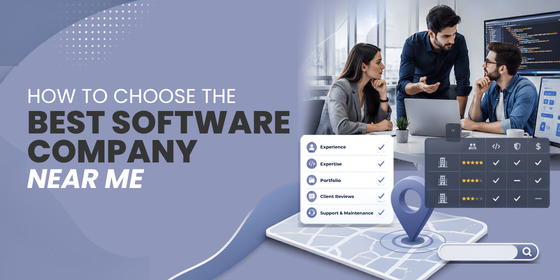
Most businesses that search for a software partner make the decision based on price alone and later pay the real cost in missed deadlines and poor delivery. Finding a How to Choose the Best Software Company Near Me. When you ask how to choose the software company near you it is a question that needs a careful and thoughtful approach. You need to think about what you want from a software company. Choosing the software company near you requires a lot of thought and a step by step process. It is not something you can decide in a hurry. You have to take your time and think carefully about the software company you want to work with. The best software company near you is not the one that is closest to you.
Introduction
The software company you pick will affect how well your business runs for years to come. If you choose one you might face delays, spend more money than planned and end up with systems that need to be replaced sooner rather than later. On the other hand a careful and thorough selection process usually leads to partnerships that bring real benefits to your business.
When looking for a software company it’s not just about finding one near you.
- It’s about checking their skills
- Their experience, in your field
- How they deliver their services
- Whether they can support you in the long term.
You need to think about software companies. Break your operations.
1. Why Proximity Alone Is Not a Selection Criterion
Geographic proximity offers convenience. It does not guarantee technical capability, delivery consistency, or domain alignment.
Proximity becomes relevant only after these criteria are confirmed:
- The company demonstrates proven technical competence in your required stack
- Their domain experience maps to your industry or operational complexity
- Their post-launch support model aligns with your internal IT capacity
2. Technical Competence: What to Evaluate First
A software company’s technical depth determines whether your solution is built to last or built to be replaced. First we have to see if they know the technology stack. This means they should be good at the programming languages, frameworks and infrastructure that our project needs. Then we have to check if they can design an architecture. This means the team should make sure that what they build can handle a lot of users is safe and easy to maintain from the beginning.
Evaluate technical competence across these dimensions:
- Technology stack expertise is very important. We need to confirm that they are proficient in the languages, frameworks and infrastructure our project requires.
- Architecture capability is also crucial. We have to assess whether the team designs for scalability, security and maintainability from the start.
- Quality assurance processes are a must. They should have structured testing protocols in place for production-grade software.
- Security practices are very important. Data protection, access controls and compliance-readiness must be part of the development process, for Technology stack expertise and Security practices.
We want to make sure that the team we work with has technology stack expertise and security practices. They should be able to design an architecture and have quality assurance processes in place. This is how we can be sure that they have the competence we need.
3. Industry Experience and Domain Relevance
Having skills is not enough to make software that really works for people. You need to know about the area the software’s for. A company that has experience, in the area as you knows what the rules are how things are done and what users want. They do not need someone to explain all these things to them from the beginning. This is because they already understand the sector and what is required. The software made by a company that knows your sector will fit your needs.
Questions to assess your domain relevance today:
- Has the company delivered projects for businesses of similar scale and complexity?
- Do they demonstrate understanding of your sector’s compliance and data requirements?
- Can they reference specific challenges in your industry that their solutions have addressed?
Software development for business growth requires a partner who understands the business context not just the code.
4. Delivery Methodology and Project Governance
How a software company manages delivery is as important as what they build. Undefined processes produce unpredictable outcomes.
Assess these governance indicators:
- When we talk about project management we use frameworks like Agile or Scrum. Sometimes we use a mix of both which is called a methodology. These frameworks have set time periods called sprints. We review what we have done at certain points called milestones.
- We need to have communication. This means we tell everyone how things are going on a basis. We also need to have a plan for when things go wrong so we can tell the people and they can help us fix the problem. All the people involved in the project should be able to see how the project is doing.
- If we need to make changes to what we’re doing we have a plan for that too. We make a plan for these changes so we do not fall behind schedule or waste a lot of money.
- We also think about what could go wrong with these changes before it actually happens with the changes. We make a list of these problems called a risk register and we come up with plans to stop them from happening or to fix them if they do. We do not just wait for problems to happen and then try to fix them.
5. Client References and Portfolio Validation
Past delivery performance predicts future behaviour more reliably than any sales conversation.
When reviewing a company’s portfolio and references:
- Request case studies specific to projects of comparable complexity
- Speak directly with former clients not just email testimonials
- Ask references specifically about delivery timeline adherence and post-launch support responsiveness
- Verification of the work presented in the portfolio was delivered by the current team
6. Support, Maintenance, and Long-Term Partnership
Software requires ongoing investment. A company that excels at development but provides inadequate post-launch support creates operational vulnerability.
Evaluate post-launch capability by confirming:
- Support tier structure Response time commitments by issue severity
- Maintenance scope What is included versus billed separately after deployment
- Roadmap collaboration Whether the company participates in planning future enhancements or simply responds to tickets
- Team continuity Whether the developers who built your system remain available for ongoing work
Conclusion
When you find the software partner they do things just right. They really understand what they are doing. They know the area they are working in. Geography is a convenience capability is the requirement. Organisations that apply a structured evaluation process before committing consistently achieve better outcomes, stronger ROI, and lower total cost of ownership over the software lifecycle.
Hands in Technology works with businesses to provide them with the technology they need. They help all sorts of companies no matter what they do by making custom software that’s just right for them. This software is made carefully and is designed to fit in with the company’s overall plan.
If you are looking for a company to work with, Hands in Technology is a choice. They have the experience and a good way of doing things and they have worked with many companies before. Hands in Technology has the skills and a good record of getting things done so they can meet the standards that businesses have.