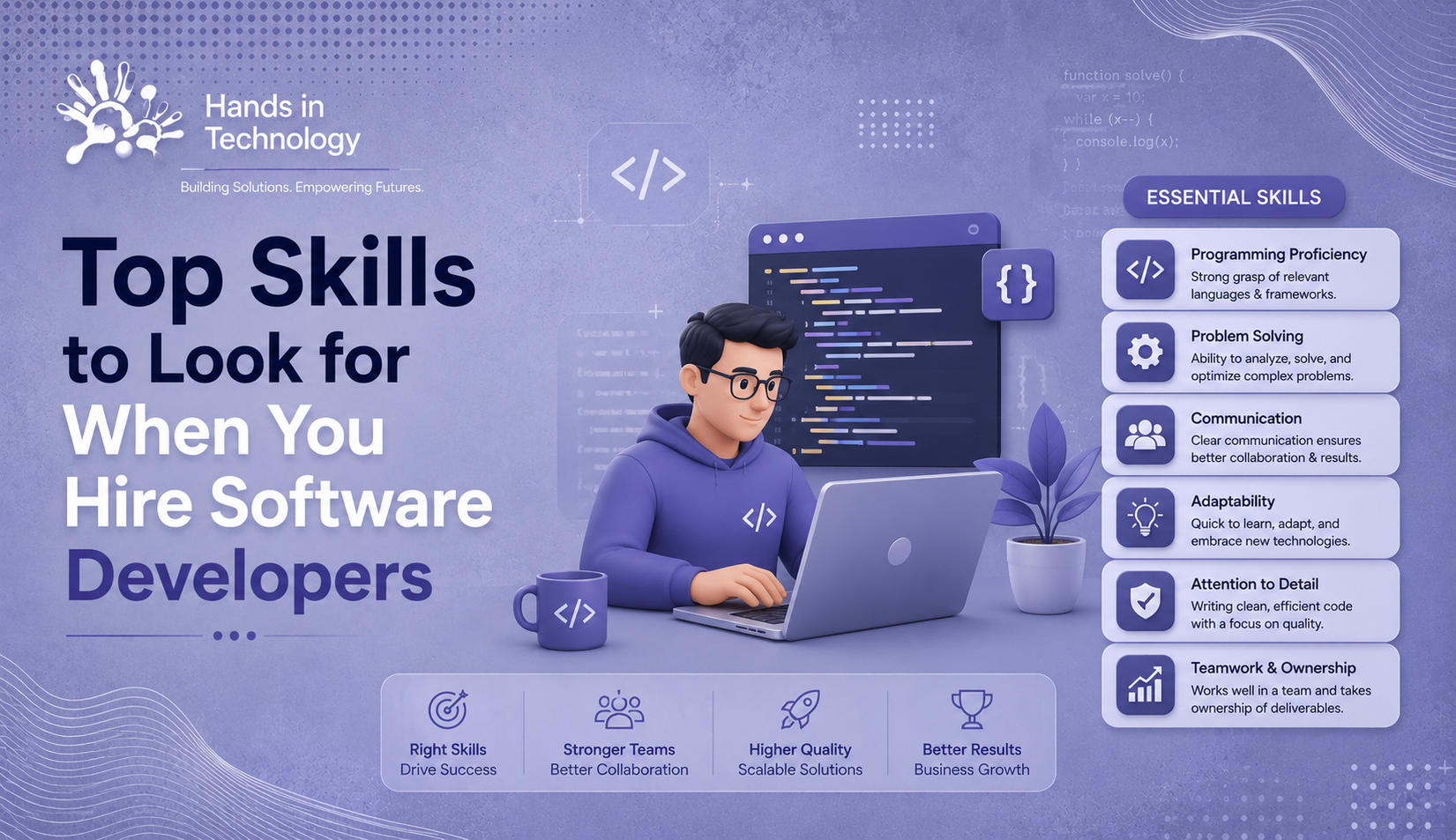
Typical companies check qualifications only-they get charged at the end. A wrong hire will delay the product launch, raise the expense and the loss of the team functions. The definition of start of your tech relations relies on the Top Skills to look for when hiring software developers.
Introduction
Technical accuracy meets professional maturity to define the discipline of software development. The resume shows skills acquired, not ability, behaviour or delivery reliability. Projects fail midway when organizations simply recruit without any standardized skills assessment process. The assessment methods employed, and even the skills required to be assessed, directly impact the success of the project. This article explains what all organizations need to check to ensure that a potential software developer hire actually meets all necessary standards.
Core Technical Proficiency
Technical proficiency is the baseline not the ceiling of developer evaluation. Verify command over the specific languages, frameworks, and tools your project requires. Generic programming knowledge does not substitute for stack-specific expertise.
Technical Skills to Verify:
- Programming languages confirm depth in required languages, not surface familiarity
- Frontend/Backend Frameworks (React, Node.js, Django, Spring) – Validation as per project stack
- Database (design/optimization, relational/non-relational query design)
- Version Control (Git workflows, branching strategies, code reviews)
- API development and integration RESTful and GraphQL API design and consumption
System Design and Architectural Thinking
What you are looking at is an system that is able to scale. A small system that works (even if through hacks, as a workaround) that has no architecture at all just is not scalable. This is one of the crucial points that senior engineers must be aware of-that you can’t architect a small system without thought given to scaling. Assess this through structured architecture discussions not multiple-choice evaluations.
Architectural Competencies to Evaluate:
- Ability to design microservices, monolithic, or serverless architectures based on project context
- The candidate knows about scalability principles-horizontal and vertical scaling
- concepts-security-by-design thinking-authentication, authorization and data security practices
- performance-caching strategies, load balancing and database indexing concepts
- Cloud computing know how about AWS/Azure/Google cloud deploy and managing
Code Quality and Engineering Practices
The quality of the code will define the future of each product. Bad quality code means the product will suffer from a technical debt that grows with each sprint. Judge code quality through exercises and live code reviews.
The engineering standards you should assess:
- Clean code practices readability, modularity, and low complexity
- Test coverage practices unit testing, integration testing and Test Driven Development (TDD)
- Documentation discipline inline comments, API documentation, and architecture notes
- Compliance with industry coding standards relevant to your technology stack
Technical debt management separates developers who build for delivery from those who build for durability.
Problem-Solving Under Real Conditions
Theoretical knowledge does not predict performance under project pressure. Assign practical, scoped tasks that mirror actual challenges in your development environment. Evaluate the approach, not just the outcome methodology reveals professional maturity.
Problem-Solving Evaluation Framework:
- Scoped assignment provide a defined problem relevant to your product domain
- Time-constrained exercise assess decision-making under realistic constraints
- Debugging challenge present existing code with embedded errors to identify and resolve
- Architecture scenario present a scaling or performance problem requiring a structured solution
- Debrief discussion ask the candidate to walk through their reasoning and trade-off decisions
Communication and Professional Accountability
A developer who cannot communicate creates project risk regardless of technical skill. Ensuring communication about status, blockers and interpretation of requirements avoids costly misunderstandings. Assess communication behavior throughout the hiring process; it’s representative of work behavior.
Indicators of professional conduct:
- Communicates technical decisions with clarity to technical and non-technical personnel
- Owns delivered product with minimum hand-holding
- Accepts criticism gracefully and adjusts approach accordingly
- Transparent about issues, delays, and scope issues
- Shows consistent professional conduct across all stages of the evaluation process
Conclusion
Organizations that continually fall down both individually and as a team hire without considering competence for any of the positions. Each competency ranging from ability to professional liability is reflected in every aspect of delivery, quality and costs.
When an organization evaluates a developer’s competencies before they hire the technological asset, integrity is upheld at every level. The Top Skills to Look for When You Hire Software Developers is a collection of required evaluative criteria which separate the organization that scales from the one which needs to be continually fixed.
Hands in Technology uses exactly these standards of competence in every developer that it screens and sends to a client for their needs. Every developer sent to your client from Hands in Technology will have been assessed on the criteria outlined in this guide before they begin to work on your client’s project.