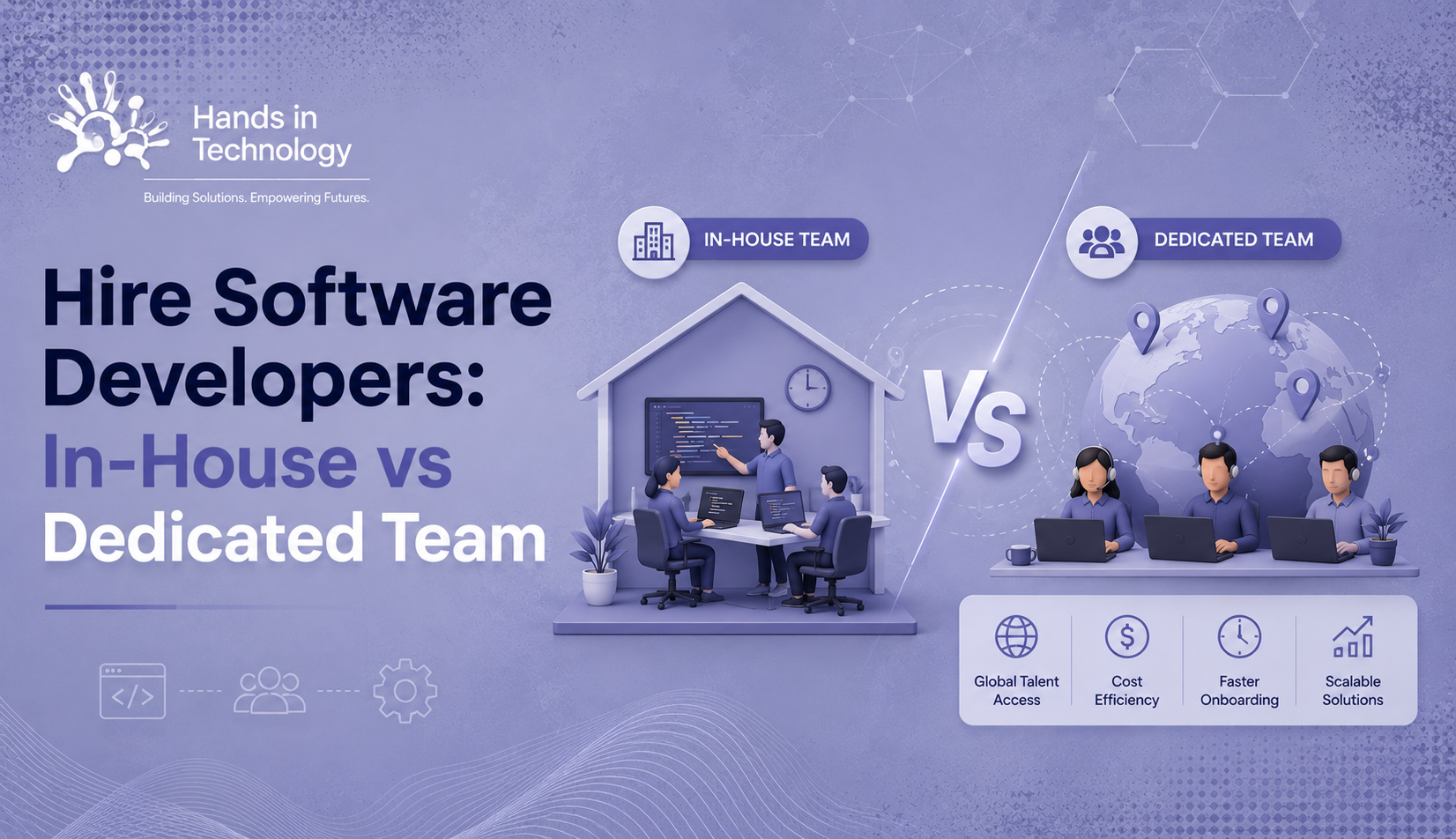
Every business that grows its technology faces a difficult choice. Internal development or a contracted third-party development team? Hire Software Developers: In-House Vs Dedicated Team isn’t a choice of preference. It’s a business decision with financial outcomes.
Introduction
The capacity for software development dictates the rate of innovation for an organization. As one considers hiring a set of software developers whether it’s on-site or with a dedicated team, one must be aware of the long term implications on business operations. Each model fits a distinct profile for each business’s specific risk-readiness and growth. It is critical for business leaders to know the structural differences between the two models so that they may strategically allocate resources. This guide will offer a business approach to selecting a model based on specific criteria.
What Is an In-House Development Model?
An in-house development model means hiring developers as full-time employees. These professionals operate within your organisation, under direct management. They align deeply with company culture, internal processes, and long-term product vision.
In-House Model Key Characteristics:
- Full organisational integration and cultural alignment
- Direct management oversight and performance accountability
- Higher fixed costs salaries, benefits, infrastructure, and onboarding
- The ability to utilize local recruitment, and availability of personnel within a certain time frame.
- The most appropriate to a company that has a consistent long-term product development.
What Is a Dedicated Development Team Model?
It acts as an extension to your existing business. The idea here is that you have domain matched, pre-screened developers on a defined contract basis. The team works exclusively on your project with defined processes and reporting structures.
Dedicated Team Model Key Characteristics:
- Rapid deployment without lengthy recruitment cycles
- Access to a global talent pool with specialised technical skills
- Flexible team composition scale up or down based on project demands
- Lower overhead compared to full-time employment structures
Cost Comparison: In-House vs Dedicated Team
Firstly, let’s talk about the price. The in house recruitment is the stable continuous expenditure and it doesn’t depend on how busy is the volume of your project work. While the team dedicated is the cost which is variable depending on your outcome.
Cost Breakdown:
| Cost Factor | In-House | Dedicated Team |
| Recruitment & Onboarding | High | Minimal |
| Monthly Salary & Benefits | Fixed overhead | Engagement-based |
| Infrastructure & Tooling | Business-funded | Vendor-managed |
| Training & Upskilling | Ongoing investment | Vendor responsibility |
| Scaling Cost | High and slow | Low and fast |
Outsourcing software development will always remain more cost-effective for economies of scale compared to hiring additional manpower for the same productivity.
Speed, Scalability, and Talent Access
In-house recruitment averages several weeks to months per hire. Dedicated team models deploy qualified developers within days. Speed of access to talent directly affects product delivery timelines and competitive positioning.
Scalability Comparison:
- In-House: Scaling requires new recruitment cycles, increased HR load, and additional infrastructure
- Dedicated Team: Scaling requires a single request to the vendor team composition adjusts rapidly
Talent Access:
- In-house hiring restricts access to local or regional talent markets
- Dedicated teams draw from global talent pools with pre-verified technical expertise
- Niche skills AI, blockchain, cloud architecture are far more accessible through dedicated models
Control, Accountability, and Risk
Control is the most cited concern when businesses evaluate dedicated team models. Professional Vendors; Clear teams in place and have defined reporting, review and escalation processes. No presence needed for accountability, only agreed upon processes and metrics.
Risk Mitigation in Both Models:
In-House Risks:
- Key-person dependency and attrition risk
- High cost of underperformance and termination processes
- Slower adaptation to new technology requirements
Dedicated Team Risks and How to Mitigate Them:
- Communication gaps → mitigated through structured daily standups and project management tools
- IP concerns → addressed through robust NDA and IP ownership clauses in contracts
- Quality consistency → maintained through defined QA processes and milestone-based delivery
Conclusion
Each type of model serves legitimate business needs, but they do not serve the same business. In-house development is appropriate for organisations that have consistent, long-term product mandates and can afford to bear fixed costs.
A dedicated development team is appropriate for businesses that require speed, scale, and cost-effectiveness while maintaining quality. Choosing whether to Hire Software Developers: An organization that have long term and stable product roadmap and is willing to absorb fixed costs should opt for In-house development.
A development team is best suited for businesses that need speed, scalability and cost efficiency along with desired quality. Making the choice of Hire Software Developers: In-House or Dedicated Team-must depend on the stage your business is currently in and not on the defaults of your industry.