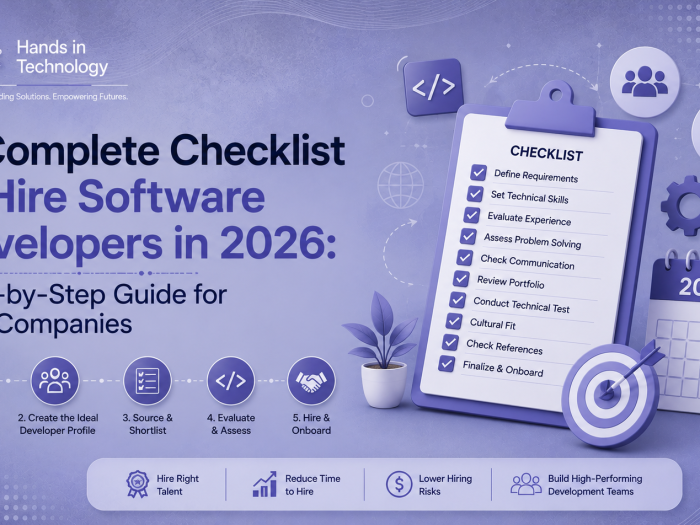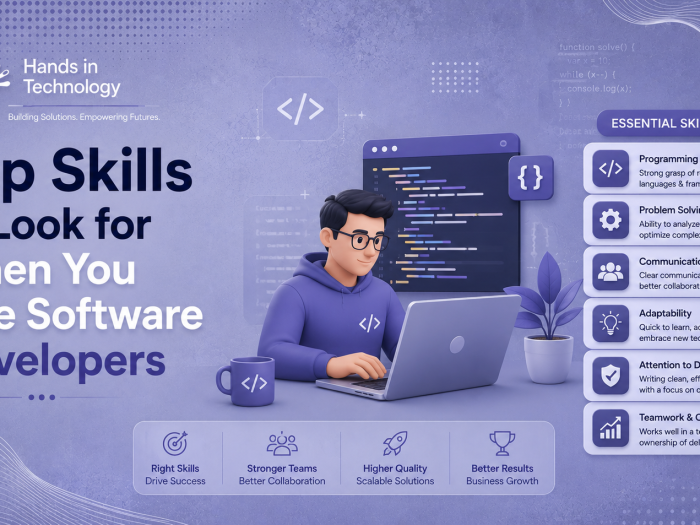
In software development, one wrong hire can delay the product road map. Short to medium-term costs from mismatched skills, poor background checks and rushes can reach tens of thousands of dollars and a criteria based methodical process starting from step one is needed for How to Hire Software Developers Without Making Costly Mistakes.
Introduction
Your lack of software development talent means a lack of success for your product. Too often though, many companies are not thinking ahead, instead making a hire in reaction to an immediate, emergency situation. The results is mismatched expectations, a delivery fail and expensive re-hiring. If you want to learn how to hire software developers without making costly mistakes, then your company has to have a consistent, predictable hiring framework. This guide will teach you each stage of the process.
Define Technical Requirements Before You Search
Misunderstood job requirements draw the wrong people to your opening and eat up interview time. Pinpoint precisely the technology stack, experience level and domain knowledge your project requires. A good job requirements definition weeds out unsuitable candidates before they even apply.
Requirements Definition Checklist:
- Primary programming languages and frameworks required
- Area of Expertise: fintech, healthtech, e-commerce, SaaS
- Experience level: junior, mid-level, senior, architect
- Engagement model: full-time, contract, project
- Expected collaboration style independent execution or team-integrated
Choose the Right Hiring Model
The hiring model determines cost structure, control, and team agility. Each model carries distinct operational implications for your business. Select based on project duration, budget, and internal management capacity.
Hiring Model Comparison:
| Model | Best For | Key Consideration |
| In-House | Long-term, core product teams | Higher overhead and onboarding cost |
| Freelance | Short-term, defined deliverables | Limited accountability and continuity |
| Dedicated Team | Scaling without in-house overhead | Requires structured vendor evaluation |
| Staff Augmentation | Filling specific skill gaps quickly | Demands clear integration planning |
Structure a Rigorous Technical Assessment
Interviews alone don’t truly gauge the competency of a developer. An objective technical test will prove skills in a way that mimics the demands of the real projects you have.Not only how much the candidate knows, but also how far the candidate knows in terms of problem-solving, elegance of code, architectural thinking.
Technical Evaluation:
- Screening round: Test the candidate’s core concepts in a short series of questions.
- Practical assignment: A small, realistic project. It’s scaled down for simplicity and representative of the actual project work.
- Code review session: Your candidate’s code is reviewed for logic, efficiency, and documentation practices.
- Architecture discussion: For senior positions, this section helps determine a candidate’s system-design thought process.
This is the simplest way to get rid of the most frequent and expensive hiring mistakes that are common when only evaluating developer candidates with interviews.
Evaluate Soft Skills and Professional Conduct
Technical competence without professional accountability creates delivery risk.A developer needs to communicate effectively, remove blockers in a timely manner and operate with ownership. Evaluate these areas with structured behavioral questions and by checking references.
Soft Skill Indicators to evaluate:
- Articulating technical decisions to non technical audience
- Previous success with time delivery without being managed closely
- How they handle ambiguity, shifting scope, technical debt
- Communication and transparency through the interview process itself
Establish Clear Contractual Expectations
Every professional engagement is a bound defined by a contract. However, ambiguities in a contract could bring you to conflict regarding scope, ownership and responsibility. Clarify your terms prior to the actual project rather than following occurrences.
Contract Essentials for Developer Engagements:
- Defined deliverables with measurable acceptance criteria
- IP and code ownership clauses full transfer upon project completion
- Confidentiality and NDA provisions covering all proprietary information
- Milestone-based payment structure tied to verified output
- Termination and dispute resolution clauses with clear timelines
Conclusion
Unstructured hiring of software developers is an unnecessary expense. All stages of requirements through contract implementation carry a calculable business risk, and businesses that adopt process-driven hiring receive proportionally greater product success and suffer fewer mid-project disasters.
Hiring Without Making Costly Mistakes: How to hire software developers with such discipline is not a luxury but a prerequisite to a successful technology venture that is expected to yield results. Hands in Technology employs this precise framework for every developer engagement that it supports. When you engage Hands in Technology, you gain qualified, domain-specific technology professionals risk-free compared to conventional hiring.